

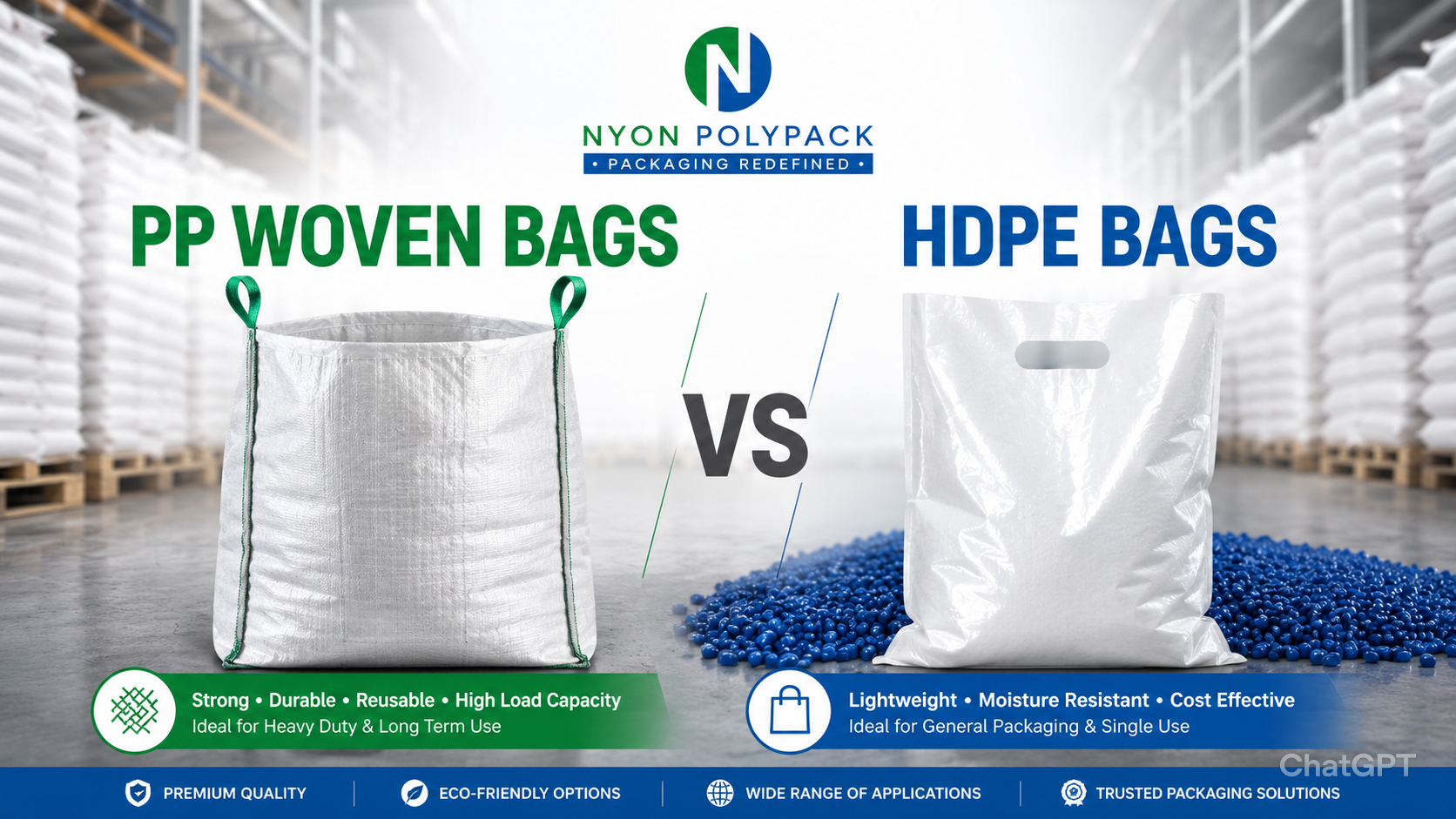
PP Woven Bags vs HDPE Bags: Key Differences, Pros & Cons
Introduction
When businesses choose packaging, they often compare different plastic materials. Two common options are PP woven bags and HDPE bags.
At first glance, both may look similar because both are plastic-based packaging materials. Both are used in commercial, industrial, agricultural, and retail sectors. But they are not the same.
The difference lies in the material, structure, strength, flexibility, printing quality, durability, and final application.
If you choose the wrong bag, you may face product leakage, poor stacking, weak branding, transport damage, or unnecessary packaging cost. But if you choose the right one, your packaging becomes a silent worker that protects your product every step of the way.
So, in this detailed comparison of PP woven bags vs HDPE bags, we’ll explain the key differences, pros and cons, and the best applications for each material.
What Are PP Woven Bags?
PP woven bags are made from polypropylene tapes woven together to form a strong fabric. The woven structure gives the bag high tensile strength and makes it suitable for bulk packaging.
These bags are widely used for packing heavy and dry products such as grains, fertilizers, cement, sugar, salt, chemicals, animal feed, pet food, and minerals.
PP woven bags can be laminated, printed, gusseted, fitted with liners, or converted into BOPP bags for premium packaging.
Main Features of PP Woven Bags
PP woven bags are known for:
- High strength
- Lightweight structure
- Good tear resistance
- Cost-effective bulk packaging
- Customizable size and GSM
- Laminated and unlaminated options
- Good printing capability
- Suitable for 5 kg to 100 kg packaging
- Reusability and recyclability
- Excellent industrial performance
The woven design is the main reason these bags are so strong.
What Are HDPE Bags?
HDPE bags are made from High-Density Polyethylene. HDPE is a strong plastic material known for stiffness, moisture resistance, and chemical resistance.
HDPE bags can be made in different forms, including liner bags, carry bags, garbage bags, packaging films, and industrial bags. Unlike PP woven bags, many HDPE bags are not woven. They are usually film-based, though HDPE woven sacks are also used in some packaging applications.
HDPE is commonly used where moisture resistance, chemical resistance, and stiffness are important.
Main Features of HDPE Bags
HDPE bags are known for:
- Good moisture resistance
- Good chemical resistance
- Lightweight structure
- Smooth surface
- Stiff feel
- Good puncture resistance in certain forms
- Suitable for liners and film packaging
- Useful in food, retail, chemical, and waste packaging
HDPE bags are practical, but they may not always match the load-bearing strength of woven PP bags for heavy-duty packaging.
PP Woven Bags vs HDPE Bags: Quick Comparison Table
| Feature | PP Woven Bags | HDPE Bags |
|---|---|---|
| Material | Polypropylene | High-Density Polyethylene |
| Structure | Woven tapes | Usually film-based or woven in some cases |
| Strength | Very high for bulk loads | Good, but depends on thickness and structure |
| Flexibility | Flexible and strong | Stiffer |
| Moisture Resistance | Good with lamination | Very good |
| Printing | Good; excellent with BOPP | Good on film surface |
| Bulk Packaging | Excellent | Moderate to good |
| Heavy Load Capacity | Better | Lower unless specially designed |
| Cost | Cost-effective for bulk sacks | Cost-effective for light/medium packaging |
| Reusability | High | Moderate to high |
| Customization | Very high | Good |
| Best For | Grains, fertilizers, cement, feed, chemicals | Liners, carry bags, films, waste bags, chemical liners |
Difference Between PP and HDPE Materials
Before comparing the bags, let’s understand the materials.
Polypropylene Explained
Polypropylene, or PP, is a thermoplastic polymer known for strength, stiffness, and resistance to fatigue. In PP woven bags, the material is converted into tapes and woven like fabric.
This woven structure creates excellent mechanical strength, making PP bags ideal for heavy-duty packaging.
PP is commonly used for:
- Woven sacks
- BOPP bags
- Food containers
- Automotive parts
- Industrial packaging
- Plastic furniture
- Ropes and fabrics
High-Density Polyethylene Explained
HDPE stands for High-Density Polyethylene. It has a dense molecular structure, which makes it strong, stiff, and resistant to moisture and many chemicals.
HDPE is commonly used for:
- Plastic bottles
- Pipes
- Liners
- Films
- Carry bags
- Chemical containers
- Garbage bags
- Packaging sheets
HDPE performs well in moisture-prone applications but may not always be the best option for heavy woven sack packaging.
1. Strength and Load Capacity
For bulk packaging, strength is one of the most important factors.
PP woven bags are designed to carry heavy loads. The woven tape structure helps distribute weight evenly and resist tearing. This makes PP woven bags suitable for 25 kg, 50 kg, and other heavy packaging requirements.
HDPE bags are strong in their own way, but film-based HDPE bags may not provide the same load-bearing capacity as PP woven bags. HDPE can be used for liners, medium-duty bags, and protective packaging, but for heavy-duty sacks, PP woven bags usually perform better.
Winner: PP Woven Bags
For bulk and heavy-duty packaging, PP woven bags are the stronger choice.
2. Flexibility and Handling
PP woven bags are flexible and easy to handle. They can be folded, stacked, stitched, laminated, and transported easily. Their woven structure gives them a fabric-like feel while maintaining strength.
HDPE bags are usually stiffer. This can be useful in some applications, but it may reduce flexibility during filling, stitching, folding, or stacking.
For manual handling and bulk transport, PP woven bags are generally easier to manage.
Winner: PP Woven Bags
PP woven bags offer better flexibility for bulk packaging operations.
3. Moisture Resistance
HDPE naturally offers very good moisture resistance. This makes it useful for liners, packaging films, and products that need water protection.
PP woven bags are not fully moisture-proof in unlaminated form because the woven structure has tiny gaps. However, when laminated with PP or PE coating, they provide much better moisture protection.
For products like fertilizers, salt, sugar, flour, and chemicals, laminated PP woven bags can perform very well.
Winner: Depends on Application
- For pure moisture barrier: HDPE bags or liners
- For strength plus moisture protection: laminated PP woven bags
4. Durability and Tear Resistance
PP woven bags are highly durable because the woven tapes resist tearing and spreading of damage. Even if one area is stressed, the woven structure helps distribute the force.
HDPE film bags may puncture or tear depending on thickness and handling conditions. Thicker HDPE bags can be durable, but for rough handling and heavy materials, PP woven bags are generally more dependable.
Winner: PP Woven Bags
For industrial handling, PP woven bags provide better durability.
5. Printing and Branding Quality
Both PP and HDPE bags can be printed, but the final result depends on surface type and printing method.
Basic PP woven bags can be flexo printed. For premium branding, PP woven bags can be laminated with BOPP film, allowing bright colors, detailed graphics, product photos, and attractive retail packaging.
HDPE film bags also support printing, especially for retail and carry bag applications. However, for heavy-duty printed sacks, BOPP laminated PP woven bags often provide better shelf appeal.
Winner: PP Woven Bags for Premium Sacks
For retail-style packaging like rice, pet food, fertilizer, and animal feed, BOPP laminated PP woven bags are a strong branding choice.
6. Cost Comparison
Both PP woven bags and HDPE bags can be cost-effective, but they serve different packaging needs.
PP woven bags are usually more cost-effective for bulk packaging because they provide high strength at a reasonable cost. Businesses can adjust GSM, size, lamination, and printing based on budget.
HDPE bags are cost-effective for light and medium packaging, liners, carry bags, and film applications.
Winner: Depends on Use
- Heavy-duty bulk packaging: PP woven bags
- Light packaging and liners: HDPE bags
7. Heat Resistance and Storage Conditions
PP has better heat resistance compared to HDPE in many practical packaging applications. This can make PP woven bags more suitable for products stored in warm warehouse conditions or transported in hot climates.
HDPE performs well at lower temperatures and remains tough, but it may soften earlier than PP when exposed to higher temperatures.
However, both materials should be stored properly away from extreme heat and direct sunlight unless UV protection is added.
Winner: PP Woven Bags
For higher temperature resistance, PP generally has an advantage.
8. Chemical Resistance
Both PP and HDPE offer good chemical resistance, but the better option depends on the chemical being packed.
HDPE is widely used for chemical containers, liners, and drums because of its strong resistance to many chemicals.
PP woven bags are also suitable for many chemical powders and granules, especially when laminated or used with PE liners.
Winner: Depends on Chemical Type
- For chemical liners and liquid-related protection: HDPE
- For dry chemical powders and granules: PP woven bags with liner or lamination
9. Reusability and Recycling
Both PP and HDPE are recyclable plastics. PP woven bags are often reused multiple times because of their strength and durability. They can also be recycled when collected and processed properly.
HDPE bags are also recyclable, and HDPE recycling is common in many plastic recycling systems.
From a sustainability point of view, responsible collection, reuse, and recycling matter more than just the material itself.
Winner: Both
Both can be recyclable and reusable depending on design, usage, and recycling infrastructure.
10. Customization Options
PP woven bags offer many customization options, especially for industrial and bulk packaging.
You can customize:
- Size
- GSM
- Color
- Lamination
- BOPP printing
- Flexo printing
- Gusset
- Liner
- Valve
- Block bottom
- UV protection
- Stitching style
- Bag capacity
HDPE bags can also be customized in terms of thickness, size, color, printing, sealing, and form.
But for woven sack packaging, PP woven bags offer more structural customization.
Winner: PP Woven Bags
For bulk sack design, PP woven bags offer more flexibility.
Common Applications of PP Woven Bags
PP woven bags are commonly used for:
- Rice packaging
- Wheat packaging
- Pulses packaging
- Sugar packaging
- Salt packaging
- Flour packaging
- Fertilizer packaging
- Cement packaging
- Chemical powder packaging
- Animal feed packaging
- Pet food packaging
- Seeds packaging
- Minerals packaging
- Construction materials
- Sandbags
They are ideal where strength, cost-efficiency, and customization are important.
Common Applications of HDPE Bags
HDPE bags are commonly used for:
- Carry bags
- Grocery bags
- Garbage bags
- Liner bags
- Food packaging liners
- Chemical liners
- Industrial films
- Retail packaging
- Medical waste bags
- Protective covers
- Moisture barrier packaging
HDPE is useful where moisture resistance, stiffness, and film-based packaging are needed.
PP Woven Bags: Pros and Cons
Pros of PP Woven Bags
- Excellent strength
- Suitable for heavy loads
- Lightweight
- Cost-effective for bulk packaging
- Customizable
- Reusable and recyclable
- Good for printing
- Available with lamination
- Suitable for many industries
- Can be made into BOPP bags
Cons of PP Woven Bags
- Unlaminated bags are not fully moisture-proof
- Require proper recycling after use
- Lower transparency compared to clear film bags
- May need UV stabilizer for outdoor storage
HDPE Bags: Pros and Cons
Pros of HDPE Bags
- Good moisture resistance
- Good chemical resistance
- Lightweight
- Smooth surface
- Useful for liners and films
- Cost-effective for light packaging
- Recyclable
- Good stiffness
Cons of HDPE Bags
- Film bags may not handle heavy bulk loads well
- Less flexible than PP woven bags
- May puncture depending on thickness
- Not always ideal for stitched heavy-duty sacks
- Limited structural options compared to PP woven sacks
Which Bag Should Your Business Choose?
The right choice depends on your product.
Choose PP woven bags if you need:
- Heavy-duty packaging
- Bulk product packing
- Fertilizer sacks
- Cement sacks
- Rice bags
- Animal feed bags
- Pet food packaging
- Chemical powder packaging
- Strong printed sacks
- BOPP laminated branding
- Custom sack design
Choose HDPE bags if you need:
- Moisture barrier liners
- Carry bags
- Garbage bags
- Film packaging
- Chemical liners
- Light or medium-duty packaging
- Protective covers
For most bulk packaging applications, PP woven bags are the better choice because they offer strength, flexibility, customization, and cost efficiency.
Why Choose Nyon Polypack for PP Woven Bags?
At Nyon Polypack, we focus on delivering packaging that fits your product, industry, and brand goals.
We manufacture and supply:
- PP woven bags
- PP woven sacks
- Raffia sacks
- PP woven fabric
- Laminated PP woven bags
- BOPP bags
- Block bottom BOPP bags
- Fertilizer grade BOPP bags
- Pet food grade BOPP bags
Our packaging solutions are suitable for agriculture, fertilizers, food grains, animal feed, pet food, chemicals, cement, construction materials, and industrial products.
We help businesses choose the right bag based on product weight, storage conditions, filling method, branding needs, and budget.
Conclusion
PP woven bags and HDPE bags are both useful packaging materials, but they are designed for different needs.
HDPE bags are excellent for moisture-resistant film packaging, liners, carry bags, and light to medium applications. But for heavy-duty packaging, bulk product handling, industrial sacks, fertilizer packaging, cement packaging, grain packaging, and branded BOPP bags, PP woven bags are usually the better option.
They offer the strength, flexibility, customization, and cost-effectiveness that modern businesses need.
If your business needs reliable, durable, and customized PP woven packaging, Nyon Polypack can help you create the right solution.
FAQs About PP Woven Bags vs HDPE Bags
1. What is the main difference between PP woven bags and HDPE bags?
PP woven bags are made from woven polypropylene tapes, while HDPE bags are made from high-density polyethylene, usually in film or liner form. PP woven bags are better for heavy-duty bulk packaging.
2. Which is stronger: PP woven bags or HDPE bags?
PP woven bags are generally stronger for heavy loads because their woven structure provides better tensile strength and tear resistance.
3. Are HDPE bags more waterproof than PP woven bags?
HDPE bags naturally offer very good moisture resistance. However, laminated PP woven bags can also provide strong moisture protection while offering better load capacity.
4. Which bag is better for fertilizer packaging?
Laminated PP woven bags are usually better for fertilizer packaging because they offer strength, moisture resistance, UV protection options, and good printing.
5. Can PP woven bags be recycled?
Yes, PP woven bags are recyclable. They can also be reused multiple times depending on the application and condition of the bag.