

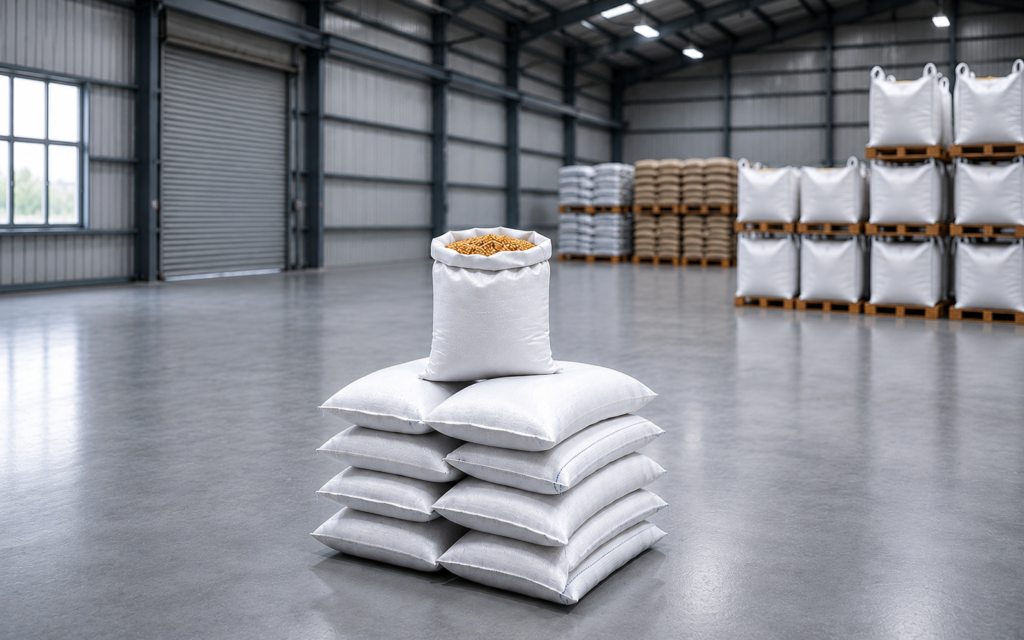
How PP Woven Bags Are Made: Manufacturing Process Explained Step by Step
Introduction
Have you ever looked at a PP woven bag and wondered how something so lightweight can carry 25 kg, 50 kg, or even heavier loads without tearing apart?
The answer lies in its manufacturing process.
PP woven bags may look simple from the outside, but behind every strong sack is a carefully controlled production process. From raw polypropylene granules to woven fabric, lamination, printing, cutting, stitching, and quality testing, every step affects the final strength and performance of the bag.
For businesses buying packaging in bulk, understanding how PP woven bags are made is extremely useful. It helps you judge quality, ask better questions, choose the right specifications, and avoid weak packaging that can damage your product or brand reputation.
In this guide, we’ll explain the complete PP woven bags manufacturing process step by step in a simple and practical way.
What Are PP Woven Bags Made From?
PP woven bags are made from polypropylene, a strong and lightweight plastic polymer. Polypropylene is converted into thin tapes, and these tapes are woven together to form fabric. The fabric is then converted into bags or sacks.
The basic structure includes:
- PP granules
- PP tapes
- Woven PP fabric
- Optional lamination
- Optional printing
- Optional liner
- Stitching or sealing
Depending on the final application, the bag may be basic, laminated, printed, gusseted, block bottom, valve type, or BOPP laminated.
Step 1: Raw Material Selection
The manufacturing process starts with selecting the right raw material.
Polypropylene Granules
Polypropylene granules are the main raw material used in PP woven bags. Good-quality granules help produce strong tapes, consistent fabric, and durable sacks.
If the raw material quality is poor, the final bag may face issues like:
- Weak tensile strength
- Uneven fabric
- Poor finishing
- Easy tearing
- Reduced load capacity
That is why raw material selection is one of the most important steps in the entire process.
Additives, Masterbatch, and UV Stabilizers
Depending on the application, manufacturers may add different materials to improve performance.
Common additives include:
- Color masterbatch for desired bag color
- UV stabilizers for sunlight resistance
- Anti-slip additives for better stacking
- Calcium filler for cost and stiffness control
- Food grade additives for food packaging applications
For example, fertilizer bags stored outdoors may require UV stabilization, while food grain bags may require food-safe material handling.
Step 2: Extrusion of PP Tapes
Once the raw material is selected, polypropylene granules are fed into an extrusion machine. Inside the machine, the granules are heated and melted.
The molten PP is then passed through a flat die to form a thin plastic film or sheet. This sheet is cooled and then cut into narrow tapes.
These tapes are the building blocks of PP woven fabric.
Think of this step like making noodles from dough. The raw material is melted, shaped, cooled, and cut into long strands — except here, the strands are plastic tapes.
Step 3: Tape Stretching and Winding
After the tapes are formed, they are stretched to improve strength. Stretching aligns the polymer molecules, making the tapes stronger and more stable.
This step directly affects the strength of the final bag.
After stretching, the tapes are wound onto bobbins. These bobbins are then used in weaving machines.
Important quality checks during this stage include:
- Tape width
- Tape thickness
- Tape strength
- Tape uniformity
- Color consistency
If tape quality is inconsistent, the woven fabric will also be inconsistent.
Step 4: Weaving the PP Fabric
The next step is weaving. The PP tapes are woven together to form fabric.
This is where the bag starts getting its real strength.
Circular Loom Weaving
Circular looms are commonly used to produce tubular woven fabric. The fabric comes out in a continuous tube shape, which can later be cut into sacks.
Circular woven fabric is widely used for standard PP woven bags and sacks.
Benefits include:
- High production efficiency
- Seamless tubular structure
- Good strength
- Suitable for bulk packaging
Flat Loom Weaving
Flat looms produce flat woven fabric. This fabric is often used for special applications, laminated products, sheets, or fabric rolls.
Flat woven fabric may be used for:
- PP woven fabric rolls
- Tarpaulin-type applications
- Special bag designs
- Industrial packaging
The weaving density, tape quality, and loom settings all influence the final fabric strength.
Step 5: Fabric Inspection
After weaving, the PP fabric is inspected for defects.
Common defects checked include:
- Broken tapes
- Uneven weaving
- Holes
- Weak edges
- Color variation
- Fabric thickness issues
This step is important because small defects in the fabric can become major failures during filling, stacking, or transportation.
A good manufacturer does not wait until the final bag is ready to check quality. Quality control starts from the fabric stage itself.
Step 6: Lamination or Coating
For products that need moisture resistance, the woven fabric is laminated.
In this process, a thin layer of PP or PE coating is applied to the fabric surface. This layer helps protect the packed product from moisture, dust, and contamination.
Laminated PP woven bags are commonly used for:
- Fertilizers
- Chemicals
- Sugar
- Salt
- Flour
- Animal feed
- Cement
- Powdered products
Lamination also improves the surface for printing and enhances the appearance of the bag.
Step 7: BOPP Film Lamination
For premium printed bags, BOPP film is laminated onto the woven fabric.
BOPP stands for Biaxially Oriented Polypropylene. It is a clear, strong, and printable film that allows high-quality graphics.
BOPP laminated bags are used when branding matters.
They are popular for:
- Rice packaging
- Pet food packaging
- Fertilizer packaging
- Animal feed packaging
- Retail food packaging
- Premium agricultural products
The biggest advantage of BOPP lamination is print quality. It allows bright colors, sharp images, and attractive designs that help products stand out on shelves.
For Nyon Polypack, this is an important product category because BOPP bags for pet food grade and fertilizer grade packaging have strong SEO and business potential.
Step 8: Printing Process
Printing turns a plain bag into a branded packaging solution. It helps businesses display their logo, product information, instructions, batch details, and marketing design.
There are two common printing methods.
Flexographic Printing
Flexographic printing is commonly used for basic PP woven sacks. It is suitable for simple designs, logos, text, and limited-color printing.
It is cost-effective and widely used for:
- Fertilizer sacks
- Cement sacks
- Grain sacks
- Industrial packaging
- Basic branded sacks
Rotogravure Printing
Rotogravure printing is used for high-quality BOPP laminated bags. It delivers premium image quality, bright colors, and detailed graphics.
It is ideal for:
- Retail rice bags
- Pet food bags
- Premium fertilizer bags
- Animal feed bags
- FMCG packaging
If your packaging needs to look attractive on retail shelves, rotogravure printed BOPP bags are usually the better choice.
Step 9: Cutting the Fabric
Once the fabric is woven, laminated, or printed, it is cut into required sizes.
The cutting size depends on:
- Bag capacity
- Product type
- Filling method
- Required length and width
- Bottom folding requirement
- Stitching margin
Accurate cutting is important because even small size variations can affect bag appearance, filling, stacking, and final capacity.
Step 10: Stitching and Bag Conversion
After cutting, the fabric pieces are stitched or converted into bags.
The bottom of the bag is usually folded and stitched with strong thread. Depending on the design, the top may remain open for filling or may include special closure options.
Common bag conversion types include:
- Bottom stitched bags
- Top hemmed bags
- Valve bags
- Block bottom bags
- Gusseted bags
- Liner inserted bags
Stitching quality is extremely important. Weak stitching can cause product leakage, especially in heavy bags.
Step 11: Adding Liners, Gussets, and Valves
Some products need additional features.
PE Liners
PE liners are inserted inside the bag for extra moisture protection. They are useful for powders, chemicals, hygroscopic materials, and food products.
Gussets
Gussets help the bag expand and hold more product. They also improve stacking.
Valves
Valve openings are used for automatic filling of cement, wall putty, chemicals, and powdered materials.
Block Bottom Structure
Block bottom bags stand upright and improve presentation, stability, and storage efficiency.
These features are selected based on the product’s handling and packaging needs.
Step 12: Quality Testing
Before dispatch, PP woven bags must go through quality checks.
Common quality tests include:
- Fabric strength test
- Tape strength test
- Stitching strength test
- Drop test
- Load capacity test
- Lamination bonding test
- Print quality inspection
- Size and weight verification
- GSM checking
- Visual inspection
Quality testing ensures that the bags can perform properly during filling, handling, stacking, transportation, and storage.
This is where professional manufacturers stand apart from low-quality suppliers.
Step 13: Bundling, Packing, and Dispatch
After passing quality inspection, the bags are counted, bundled, compressed, packed, and prepared for dispatch.
Proper bundling helps with:
- Easy counting
- Safe transportation
- Space saving
- Better warehouse handling
- Damage prevention
The final packaging is then delivered to the customer as per order quantity and specifications.
Common Customization Options in PP Woven Bags
One of the biggest advantages of PP woven bags is customization.
Businesses can customize:
- Bag size
- Bag color
- Fabric GSM
- Lamination type
- Printing design
- Number of printing colors
- BOPP film design
- Gusset size
- Liner thickness
- UV protection
- Valve type
- Block bottom structure
- Handle options
- Thread color
- Packing quantity
This flexibility makes PP woven bags suitable for almost every industry.
Why Manufacturing Quality Matters
A PP woven bag is only as good as the process used to make it.
Poor manufacturing can lead to:
- Bag tearing
- Weak stitching
- Poor printing
- Moisture leakage
- Uneven sizes
- Low load capacity
- Product loss
- Customer complaints
- Brand damage
On the other hand, high-quality manufacturing ensures:
- Better product protection
- Stronger packaging
- Improved shelf appeal
- Lower wastage
- Better customer satisfaction
- More reliable supply chain
For buyers, this means one thing: do not choose packaging only based on price. Choose based on quality, consistency, and manufacturer reliability.
Why Choose Nyon Polypack?
At Nyon Polypack, we understand that packaging is not just about covering a product. It is about protecting your product, improving your brand image, and making transportation easier.
We provide customized packaging solutions such as:
- PP woven sacks
- PP woven bags
- Raffia sacks
- PP woven fabric
- BOPP bags
- Block bottom BOPP bags
- Fertilizer grade BOPP bags
- Pet food grade BOPP bags
Our focus is on strength, quality, customization, and reliable delivery.
Whether you need basic woven sacks for bulk products or premium BOPP laminated bags for retail packaging, Nyon Polypack can help you select the right solution.
Conclusion
The manufacturing process of PP woven bags is detailed, technical, and quality-driven. From selecting polypropylene granules to extrusion, tape stretching, weaving, lamination, printing, cutting, stitching, testing, and dispatch — every step matters.
A well-made PP woven bag protects the product, supports heavy loads, improves branding, and performs reliably during storage and transportation.
For businesses, understanding this process helps in choosing better packaging and better suppliers. And when you work with a trusted manufacturer like Nyon Polypack, you get bags designed according to your product, industry, and branding needs.
FAQs About PP Woven Bag Manufacturing
1. What raw material is used to make PP woven bags?
PP woven bags are mainly made from polypropylene granules. Additives such as color masterbatch, UV stabilizers, and fillers may also be used depending on the application.
2. How are PP woven bags made?
PP granules are melted and converted into tapes. These tapes are stretched, wound, woven into fabric, laminated or printed if required, cut into sizes, stitched into bags, tested, packed, and dispatched.
3. What is the difference between laminated and unlaminated PP woven bags?
Laminated PP woven bags have a coating layer for moisture protection, while unlaminated bags are breathable and more economical.
4. What is BOPP lamination in PP woven bags?
BOPP lamination involves applying printed BOPP film onto PP woven fabric. It improves appearance, print quality, moisture resistance, and branding.
5. Why is quality testing important in PP woven bag manufacturing?
Quality testing ensures that the bags have proper strength, size, stitching, lamination, printing, and load-bearing capacity before they are delivered to customers.